Project Staff, Khagrachhari:
Initiatives have been proposed to improve access to safe drinking water, sanitation and renewable energy in eight paras under the Golabari Cluster through the Climate Resilient Livelihoods Improvement and Water Management in the CHT Sector Project (CRLIWM-CHT Sector Project).
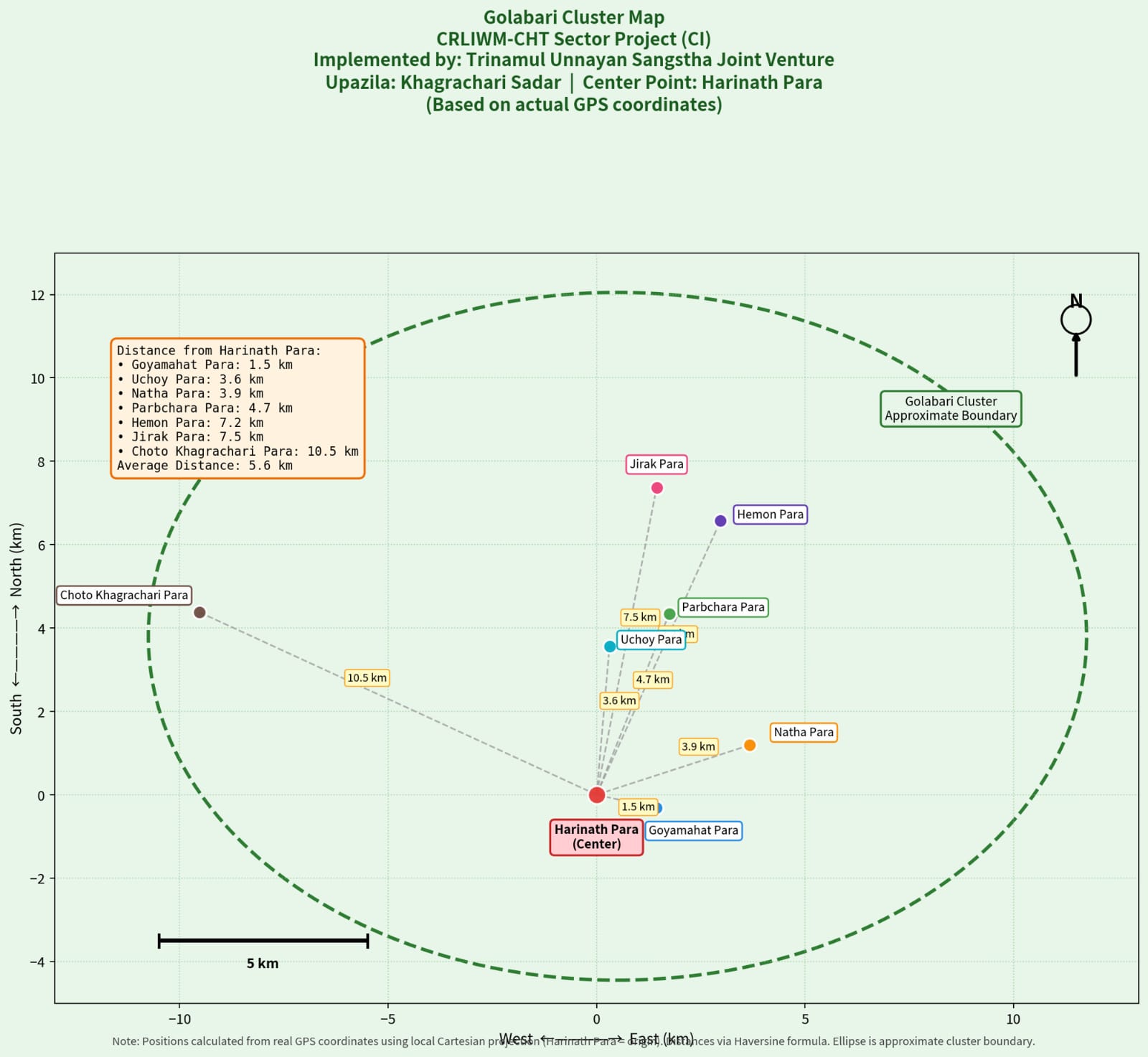
The proposed interventions have been identified through para-level social mapping, community consultations and assessments of existing facilities and local needs. The eight paras covered by the assessment are Natha Para, Parbochhara Para, Goamahat Para, Uchoy Para, Choto Khagrachhari Para, Jirok Para, Hemon Para and Horinath Para.
According to the Golabari Cluster Feasibility Study Report (FSR), the cluster comprises 355 households with a total population of 1,601. Of the total population, 897 are from the Tripura community and 704 from the Chakma community. The cluster also includes 23 female-headed households, 97 elderly people and 25 persons with disabilities.
Social Mapping and Identification of Community Needs
Social mapping and community consultations played an important role in identifying the existing facilities, geographical conditions, available water sources and priority needs of each para. The process helped identify gaps in safe drinking water, sanitation and household electricity access and supported the selection of appropriate interventions.
The assessment indicates that seven of the eight paras have inadequate access to safe drinking water. It also highlights the limited availability of grid electricity and the low coverage of sanitary latrines across the cluster.
Based on these findings, the proposed interventions have been tailored to the needs and circumstances of individual paras.
Para-wise Proposed Interventions
1. Natha Para
Natha Para has 36 households with a population of 173. The proposed interventions include the installation of two solar-powered deep tube wells, along with pumps, water distribution pipelines, tapstands and water storage tanks. In addition, 36 households are proposed to receive 65-watt solar home systems to improve access to electricity.
2. Parbochhara Para
Parbochhara Para comprises 20 households with a population of 93. As the community mainly depends on dug wells and streams for water, the proposed interventions include two solar-powered deep tube wells with pumps, pipelines, tapstands and storage tanks. The plan also includes 20 twin-pit sanitary latrines and 20 household solar systems, each with a capacity of 65 watts.
3. Goamahat Para
Goamahat Para has 52 households and a population of 263. The proposed intervention focuses on improving access to safe drinking water through the installation of three solar-powered deep tube wells, including pumps, distribution pipelines, tapstands and water storage tanks.
4. Uchoy Para
Uchoy Para comprises 56 households with a population of 279. The proposed facilities include one solar-powered deep tube well, one shallow tube well, 30 twin-pit sanitary latrines and 30 household solar systems with a capacity of 65 watts each.
5. Choto Khagrachhari Para
Choto Khagrachhari Para has 41 households and a population of 173. The proposed interventions include one solar-powered deep tube well, one shallow tube well and 41 household solar systems, each with a capacity of 65 watts. According to the community's expressed priorities, households intend to construct their own sanitary latrines once access to safe drinking water is ensured.
6. Jirok Para
Jirok Para comprises 41 households with a population of 159. The proposed interventions include two solar-powered deep tube wells, 25 twin-pit sanitary latrines and 20 household solar systems with a capacity of 65 watts each.
7. Hemon Para
Hemon Para has 27 households and a population of 113. As an existing deep tube well installed with support from KHDC-UNDP serves the para, no new water supply facility has been included in the proposed intervention plan. Instead, the plan prioritises 26 twin-pit sanitary latrines, 26 household solar systems with a capacity of 65 watts and the construction of a 25 ft × 15 ft weaving shed to support women's traditional handloom weaving activities and livelihood opportunities.
8. Horinath Para
Horinath Para is the largest para in the cluster, with 82 households and a population of 348. The proposed interventions include two grid-powered deep tube wells with pumps, distribution pipelines, tapstands and storage tanks, one shallow tube well and 40 twin-pit sanitary latrines. Although the para has several existing tube wells, some poor and landless households still depend on neighbouring households for access to water.
Overall Development Plan
The consolidated intervention plan for the eight paras includes:
-
11 solar-powered deep tube wells;
-
2 grid-powered deep tube wells;
-
3 shallow tube wells;
-
141 twin-pit sanitary latrines;
-
173 household solar systems, each with a capacity of 65 watts; and
-
1 weaving shed to support women's traditional weaving activities.
The estimated total cost of the proposed interventions is BDT 20,821,166 (approximately BDT 2.08 crore).
Community Participation and Sustainability
The assessment process involved community consultations to identify local priorities and understand the challenges faced by residents. According to the FSR, a total of 24 consultation meetings were conducted, with 604 participants, including 292 women.
Community participation is expected to remain important during implementation, particularly in selecting suitable sites, ensuring the proper use of facilities and establishing effective operation and maintenance arrangements. The proposed water supply, sanitation, solar energy and livelihood-support facilities are intended to improve living conditions and strengthen the resilience of communities in the cluster.
The Golabari Cluster FSR provides a preliminary basis for planning these interventions. Final implementation will require confirmation of technical designs, quantities, specific site locations and relevant land donation documentation.
Through these community-informed initiatives, the CRLIWM-CHT Sector Project aims to address essential infrastructure gaps and contribute to improved living standards and climate-resilient livelihoods in the remote and hilly paras of the Golabari Cluster.