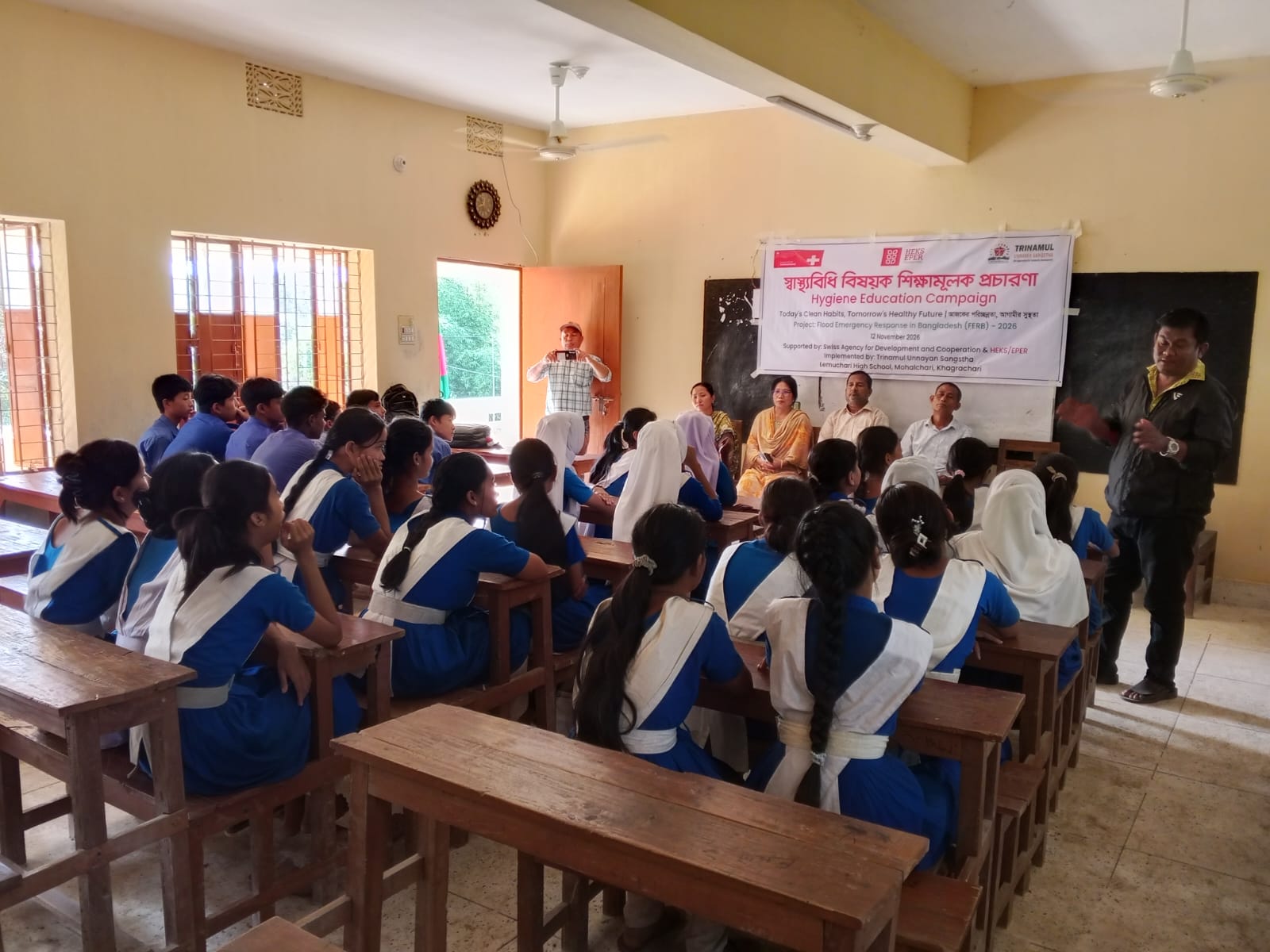
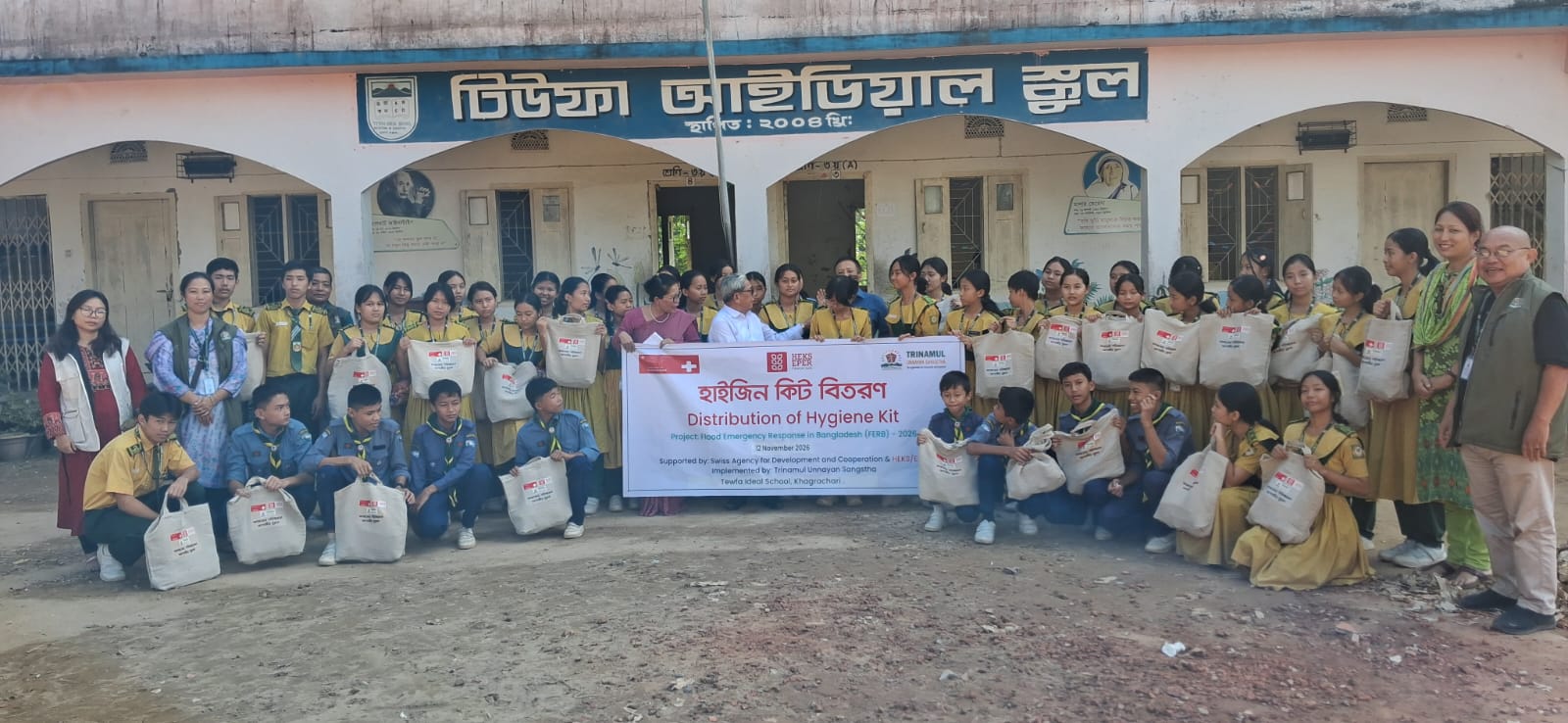
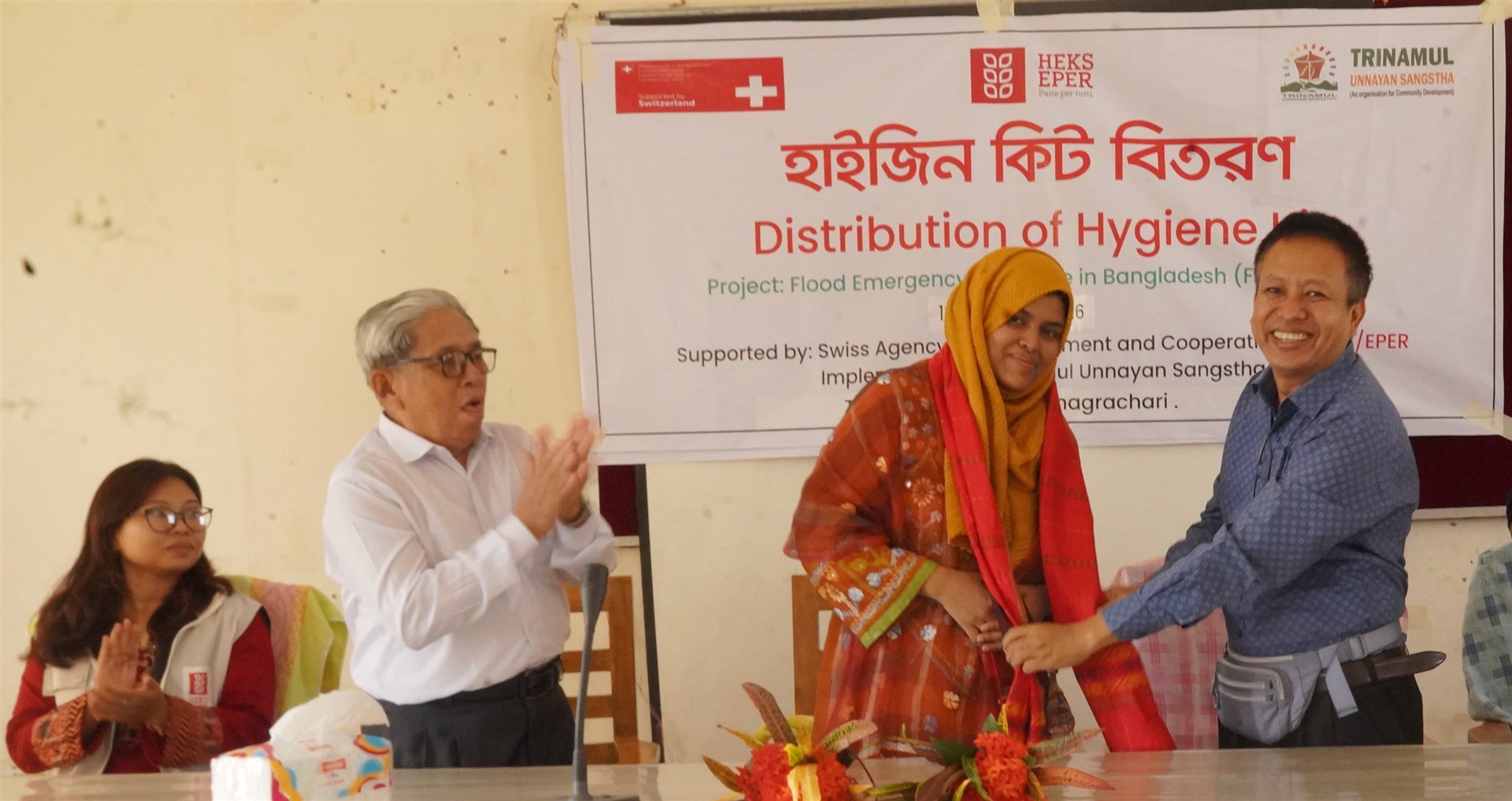
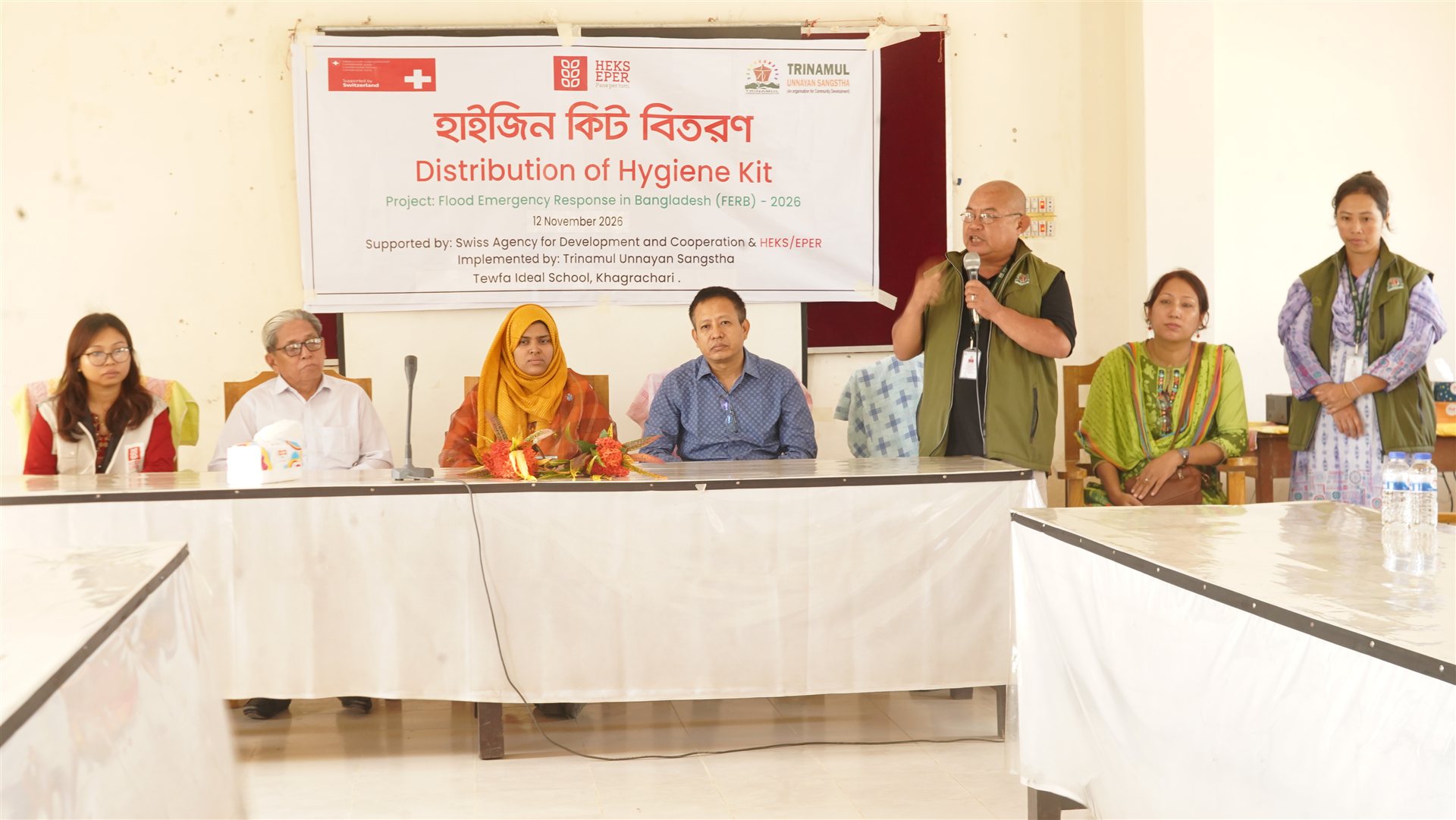
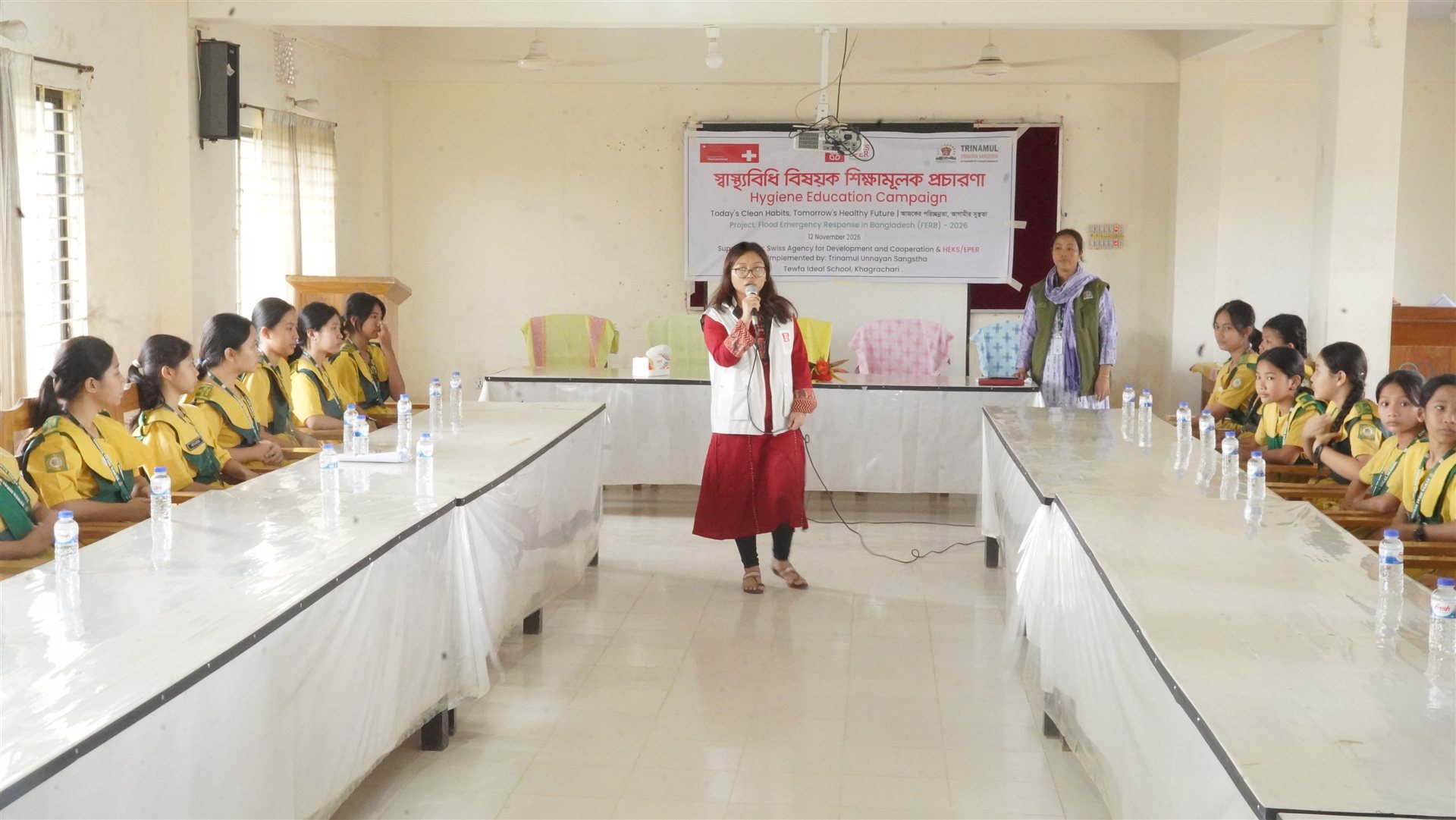
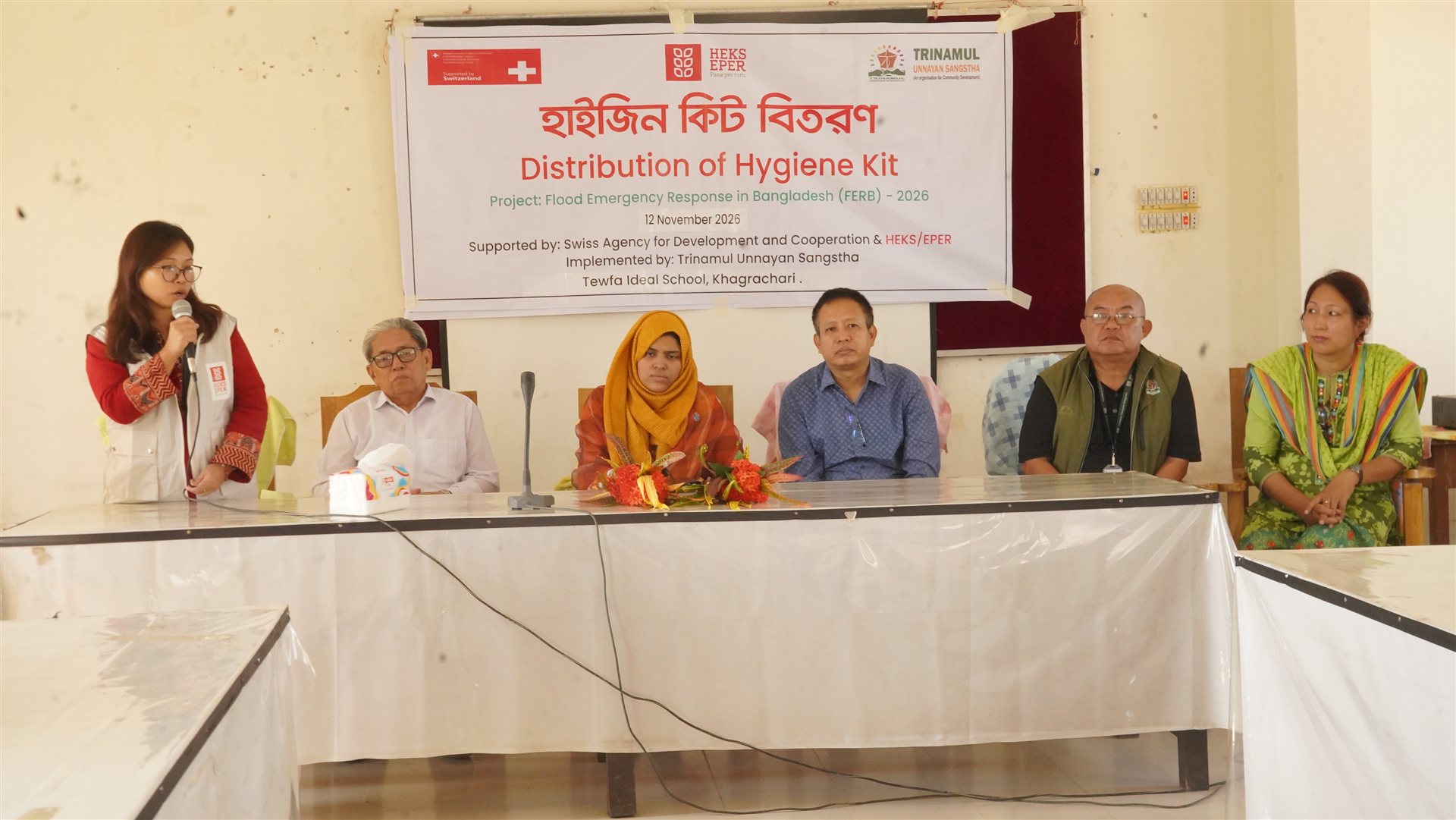
Khagrachari, 12 November 2026 – Ms. Faria Sultana, Upazila Nirbahi Officer (UNO), visited the activities of the Flood Emergency Response in Bangladesh (FERB) project at TEWFA Ideal School, Khagrachari, today. The visit coincided with a Hygiene Education Campaign at school level and the distribution of hygiene kits to students. The project is supported by the Swiss Agency for Development and Cooperation (SDC) and HEKS/EPER, and is implemented by Trinamul Unnayan Sangstha (TUS), which also organised the programme.
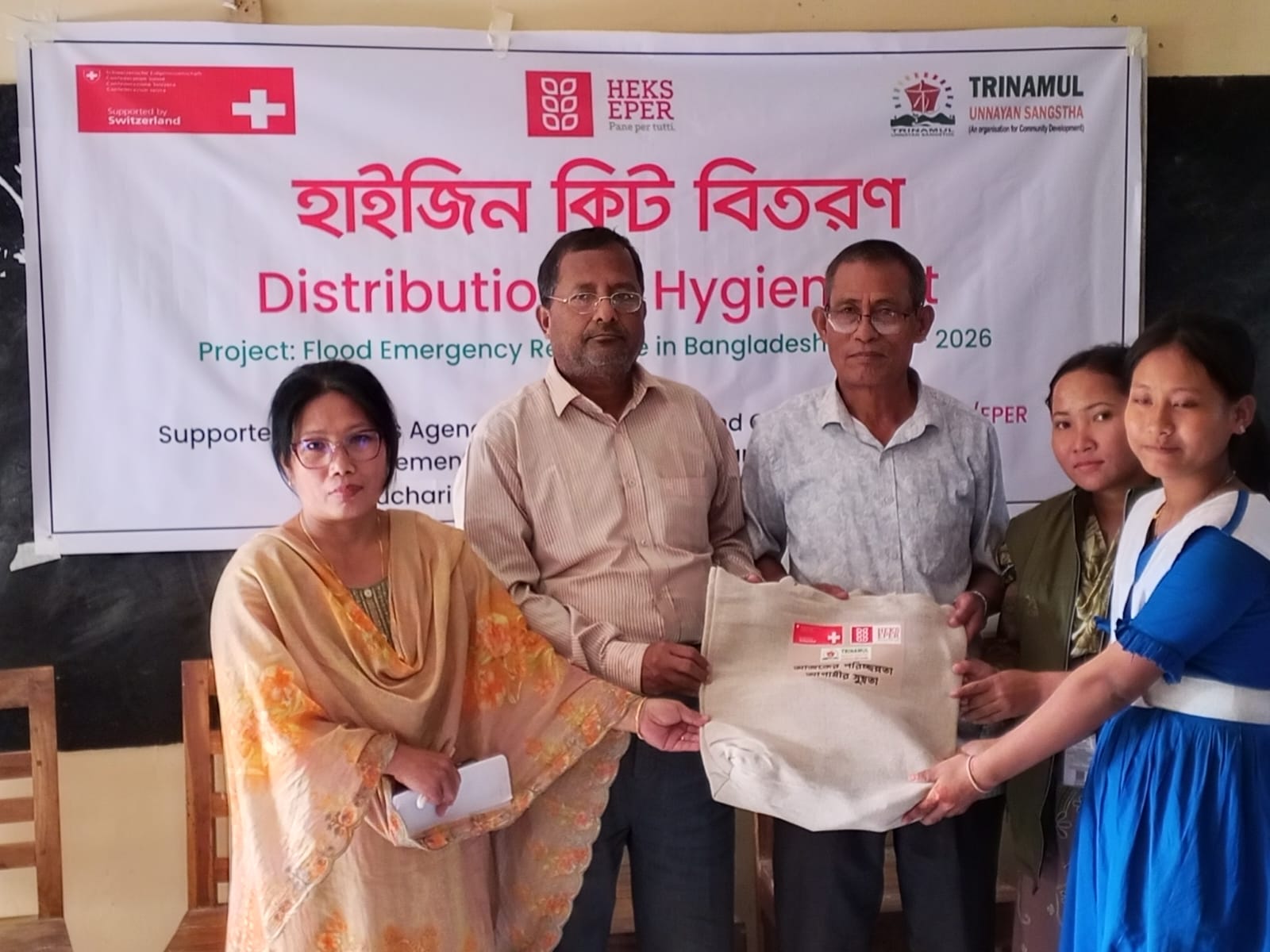
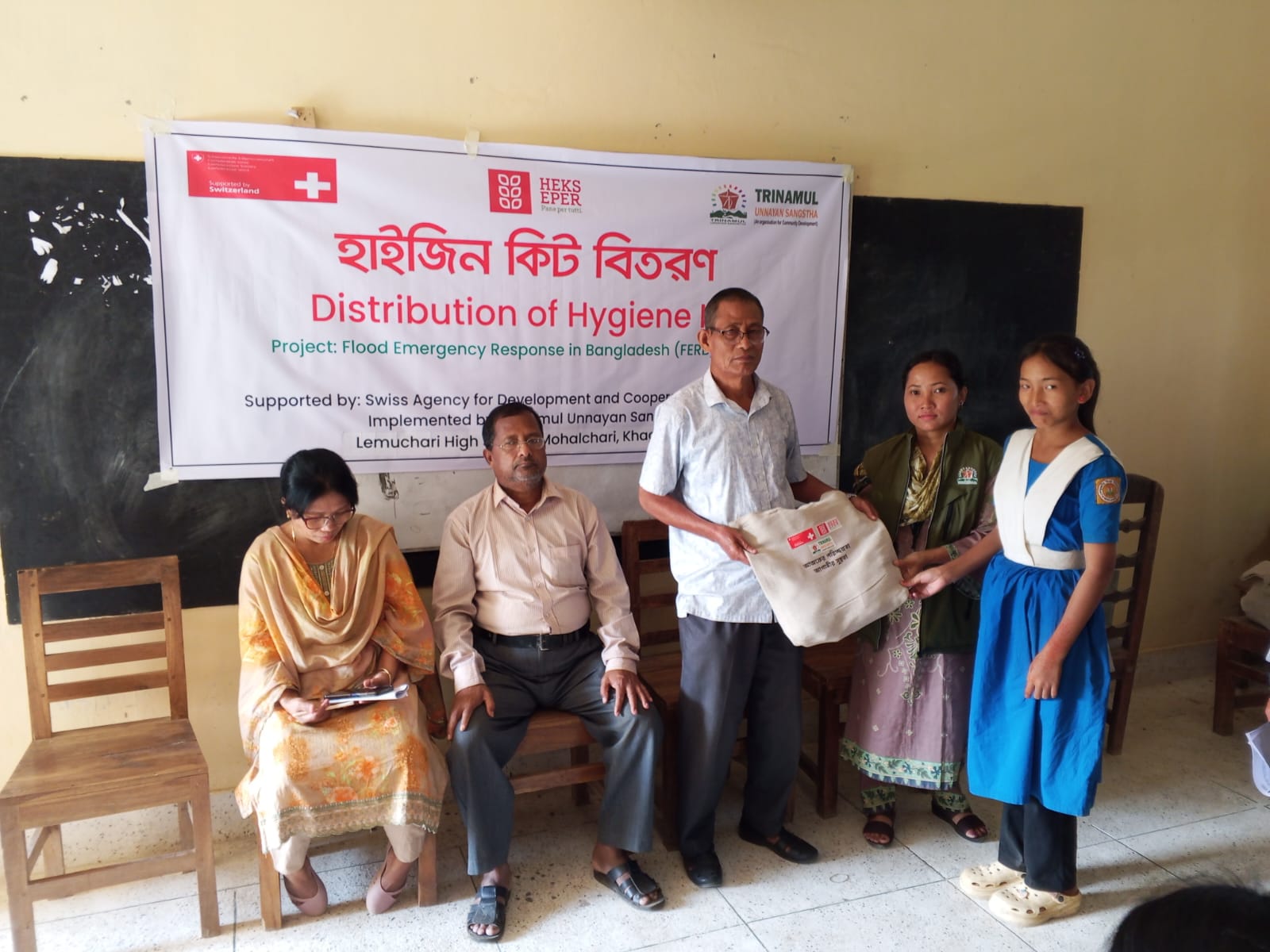
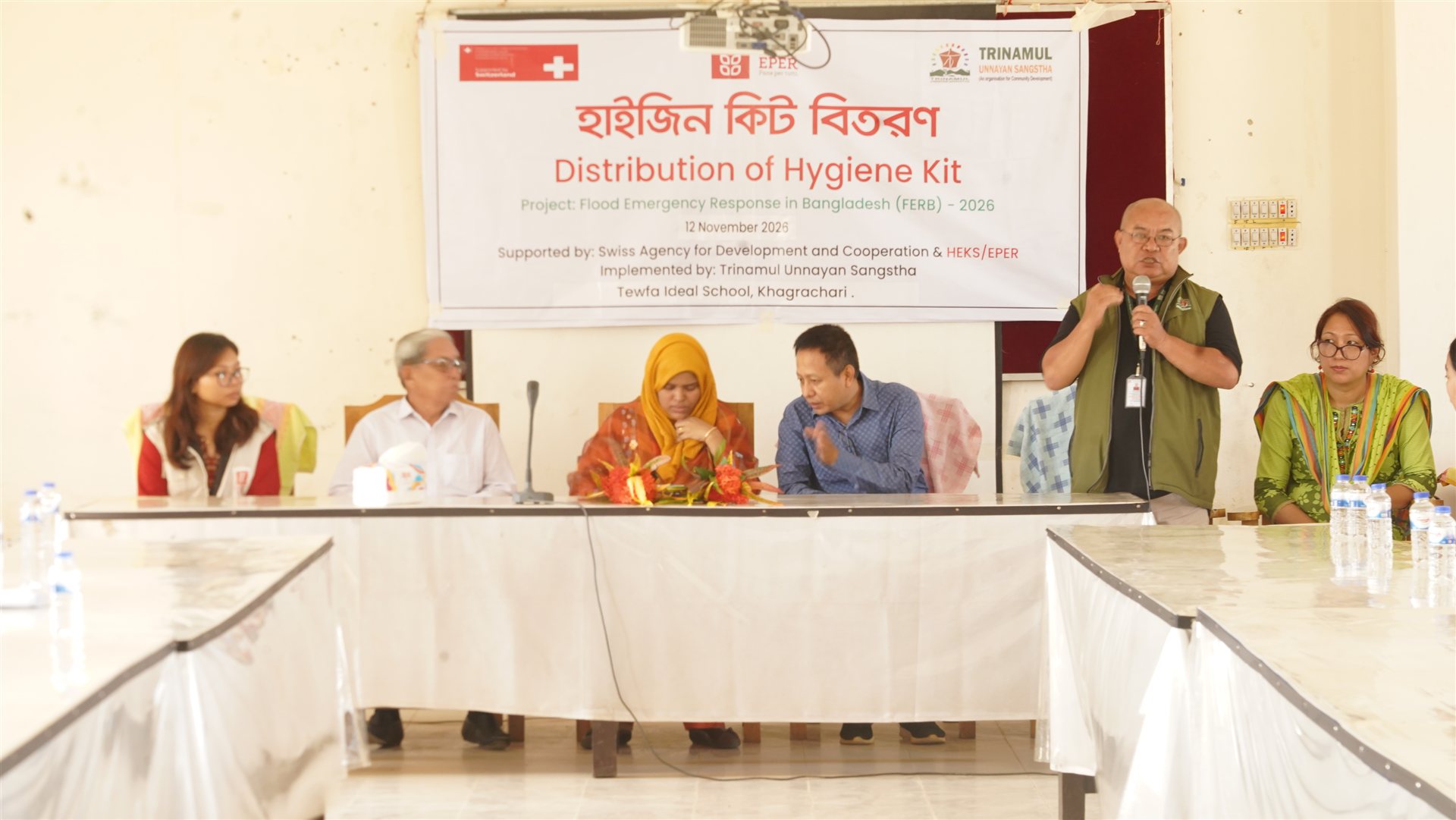
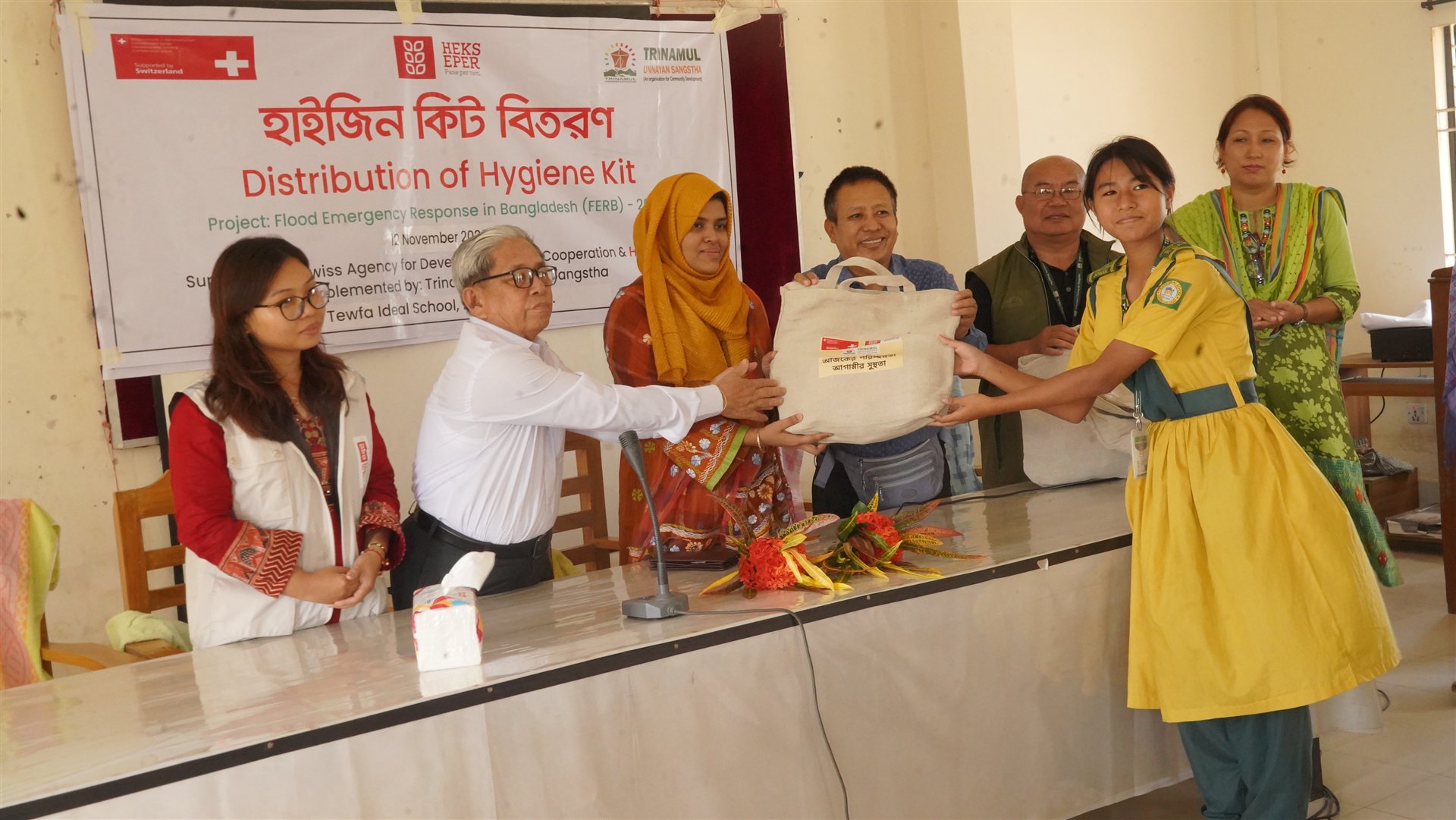
Forty hygiene kits were handed over to students at the event, 30 of them to female students and 10 to male students. Among those present were School Principal Ghanashyam Dewan, Ripan Chakma, Executive Director of TUS, and Tribeni Chakma, representing HEKS/EPER, along with teachers and students who took part in the session and received their kits from the guests.
Biplob Chakma, Project Manager of the FERB project at TUS, briefed the audience about the project and specially highlighted its hygiene component. He said that TUS began its hygiene campaign on 28 October 2026 and started kit distribution on 10 November 2026. So far, TUS has distributed 430 hygiene kits to nine schools in Mohalchari, Khagrachari Sadar and Dighinala upazilas, against a target of 500 kits to be distributed in 2026.
Speaking at the event, Ms. Faria Sultana, UNO, said: “Girls must be aware of menstrual hygiene. It is a natural part of life and should not be hidden. I thank TUS and its partners for bringing this important message and these hygiene kits to our students.” Her message to the adolescent girls in the room was clear: menstruation is nothing to be ashamed of, and open conversation, correct knowledge and safe hygiene practice protect both health and dignity.
Ripan Chakma, Executive Director of TUS, thanked the UNO for being present and expressed his gratitude. He said: “We are grateful to the UNO for taking time to join us today. Good hygiene protects children’s health and keeps them in school, especially after the floods. We also thank the school authorities for giving us the opportunity to organise this programme.” He also thanked the school authorities for opening their doors to the campaign and for their cooperation in reaching the students.
The programme comes in the wake of the July 2026 floods. Continuous monsoon rainfall between 4 and 12 July caused severe flooding in the eastern and southern parts of Bangladesh and affected around 1.11 million people across ten districts, according to UN reporting. In Khagrachari, all nine upazilas were affected, with damage to shelters, roads, bridges, schools, water points and farmland. Flooding also submerged or damaged water points and sanitation facilities, disrupting access to safe drinking water and hygiene services and raising the risk of waterborne diseases. Many Indigenous communities of the Chattogram Hill Tracts live in remote hilly terrain where poor road connectivity delays emergency response and recovery.
FERB is a 12-month integrated flood recovery and resilience project running from September 2026 to August 2027. In Khagrachari, covering Dighinala, Mohalchari and Sadar upazilas, TUS implements the project under the supervision and technical support of HEKS/EPER, combining water, sanitation and hygiene (WASH), shelter and livelihood recovery support to improve the safety, dignity and resilience of flood-affected families. Its first objective is to restore access to safe water, sanitation and hygiene services for flood-affected households and to reduce the risk of waterborne diseases.
The hygiene work under this objective operates at household, school and community level. It includes the distribution of hygiene kits, restoration of household handwashing stations, awareness sessions on disease prevention, hand hygiene and menstrual hygiene management, and school and community hygiene campaigns such as the one held at TEWFA Ideal School, backed by community-led sanitation campaigns and community committees that maintain water and sanitation facilities. Priority is given to Indigenous communities, women-headed households, older persons, persons with disabilities, children, pregnant and lactating women and adolescent girls, and the project’s child-sensitive support includes menstrual hygiene management kits so that girls can manage menstruation safely and with dignity.
Schools are among the most effective places to build hygiene habits that last. Children who learn about handwashing, safe water use and menstrual hygiene in the classroom often carry these habits home to their families, and adolescent girls who understand menstruation are better able to attend school with confidence. By combining an education session with the handing over of kits, the campaign at TEWFA Ideal School aims to turn knowledge into daily practice. Students were encouraged to use their kits regularly, to share what they learned with siblings, parents and neighbours, and to speak openly with teachers when they have questions about health and hygiene.
The event also showed the value of partnership between local administration, schools, civil society and donors. The presence of the UNO, the school principal and teachers, TUS leadership and the HEKS/EPER representative on the same platform reflected a shared commitment to the wellbeing of flood-affected children. The Swiss support through SDC and HEKS/EPER, delivered locally through TUS, is helping communities not only to recover from the floods but also to be better prepared for future climate-related shocks, in a region where remote terrain and limited access often leave families underserved.
TUS and HEKS/EPER carry out the project through community consultations, a confidential feedback and complaint mechanism, post-distribution monitoring and regular review meetings, in coordination with the district and upazila administration, line departments, local government institutions and traditional leaders. TUS will continue school-level hygiene education and kit distribution in the remaining weeks of 2026 and into 2027, working with school authorities, teachers, students and local administration, so that good hygiene practice, especially among adolescent girls, becomes a lasting foundation for health, school attendance and community resilience.
About the organisations: Trinamul Unnayan Sangstha (TUS) is a local organisation for community development working in Khagrachari. HEKS/EPER is the Swiss humanitarian and development organisation of the Evangelical Reformed Church of Switzerland. The Swiss Agency for Development and Cooperation (SDC) is the Swiss Confederation’s international cooperation agency.
TEWFA Ideal School photo highlights
12 November 2026. Photos: TUS.
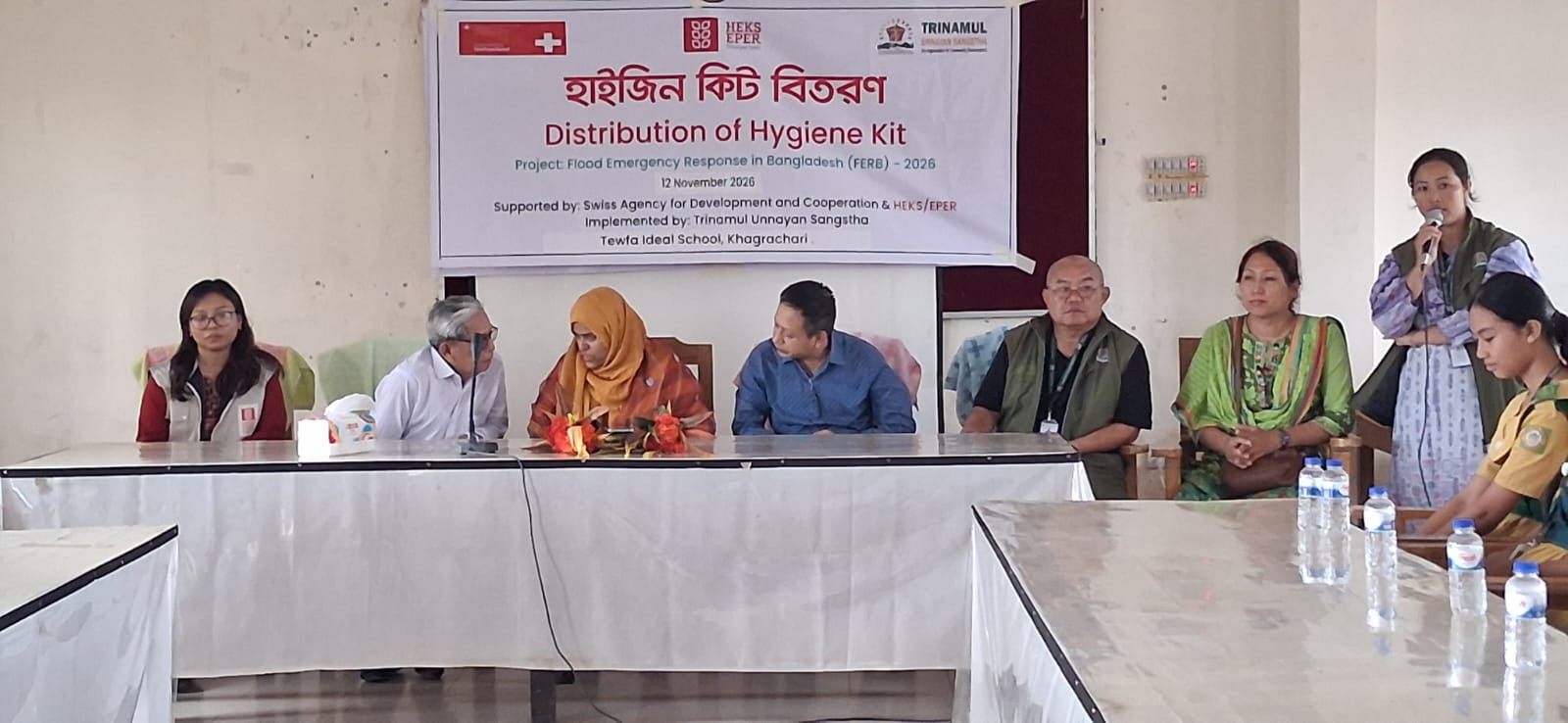
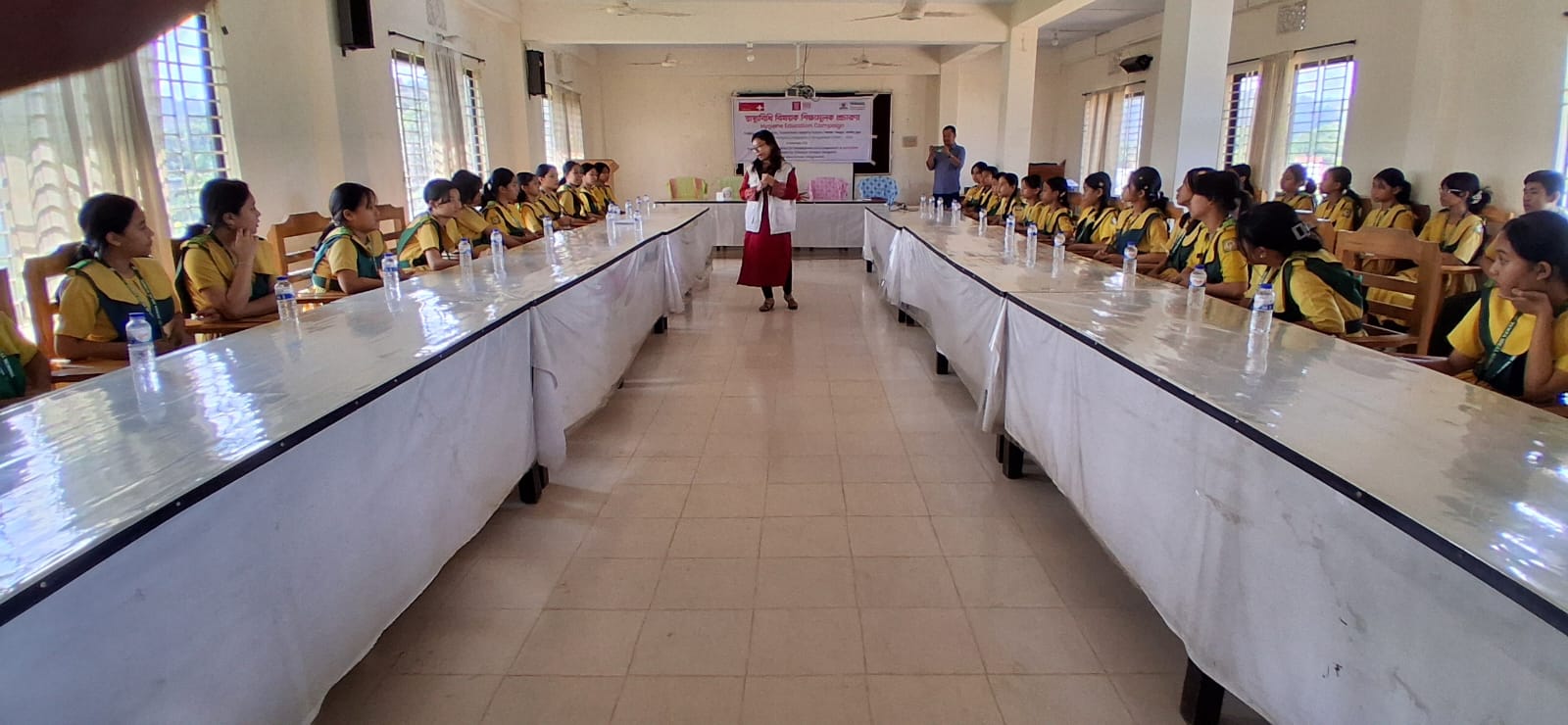

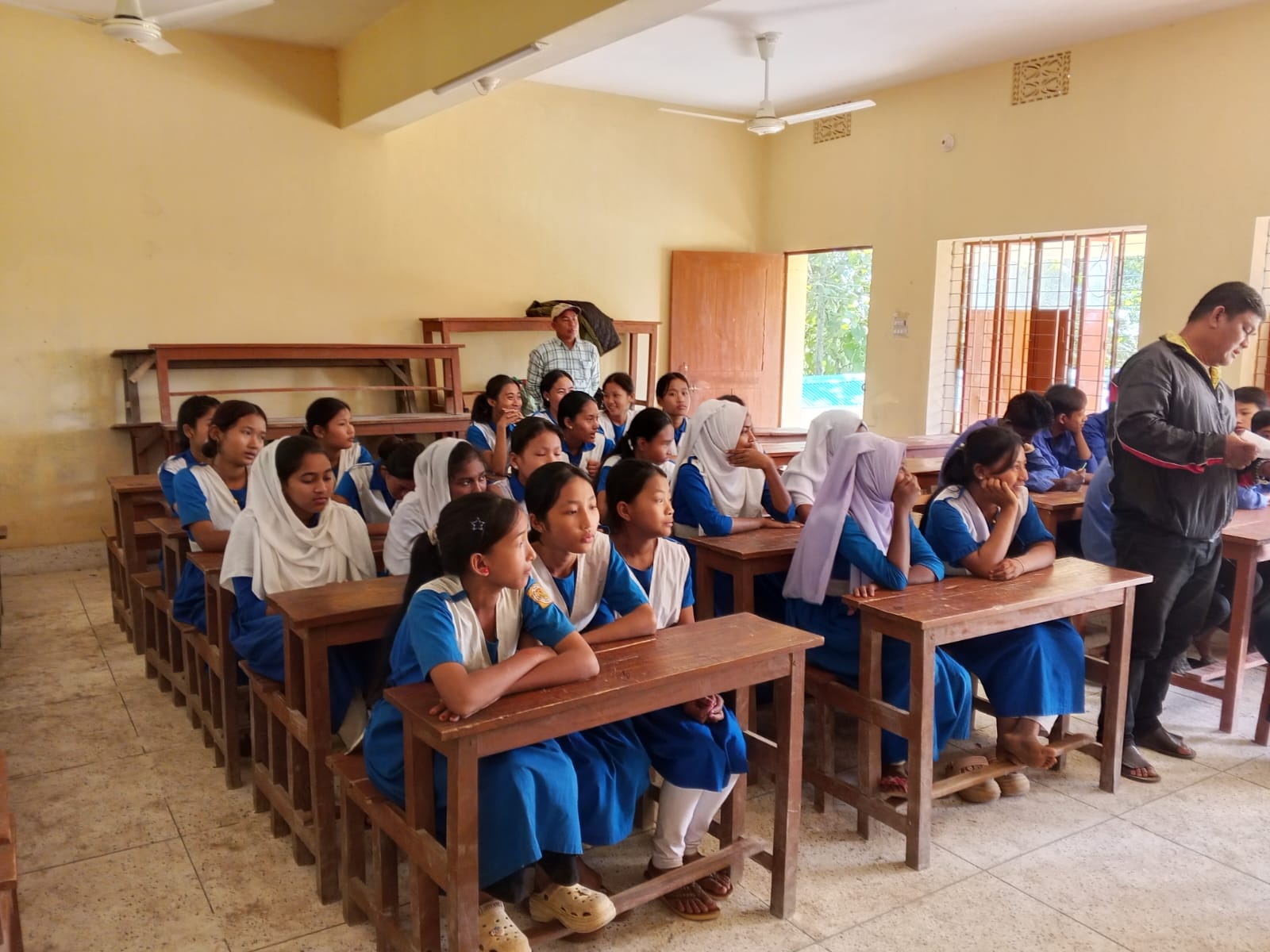
More highlights from TEWFA Ideal School
Hygiene education and kit distribution, 12 November 2026. Photos: TUS.
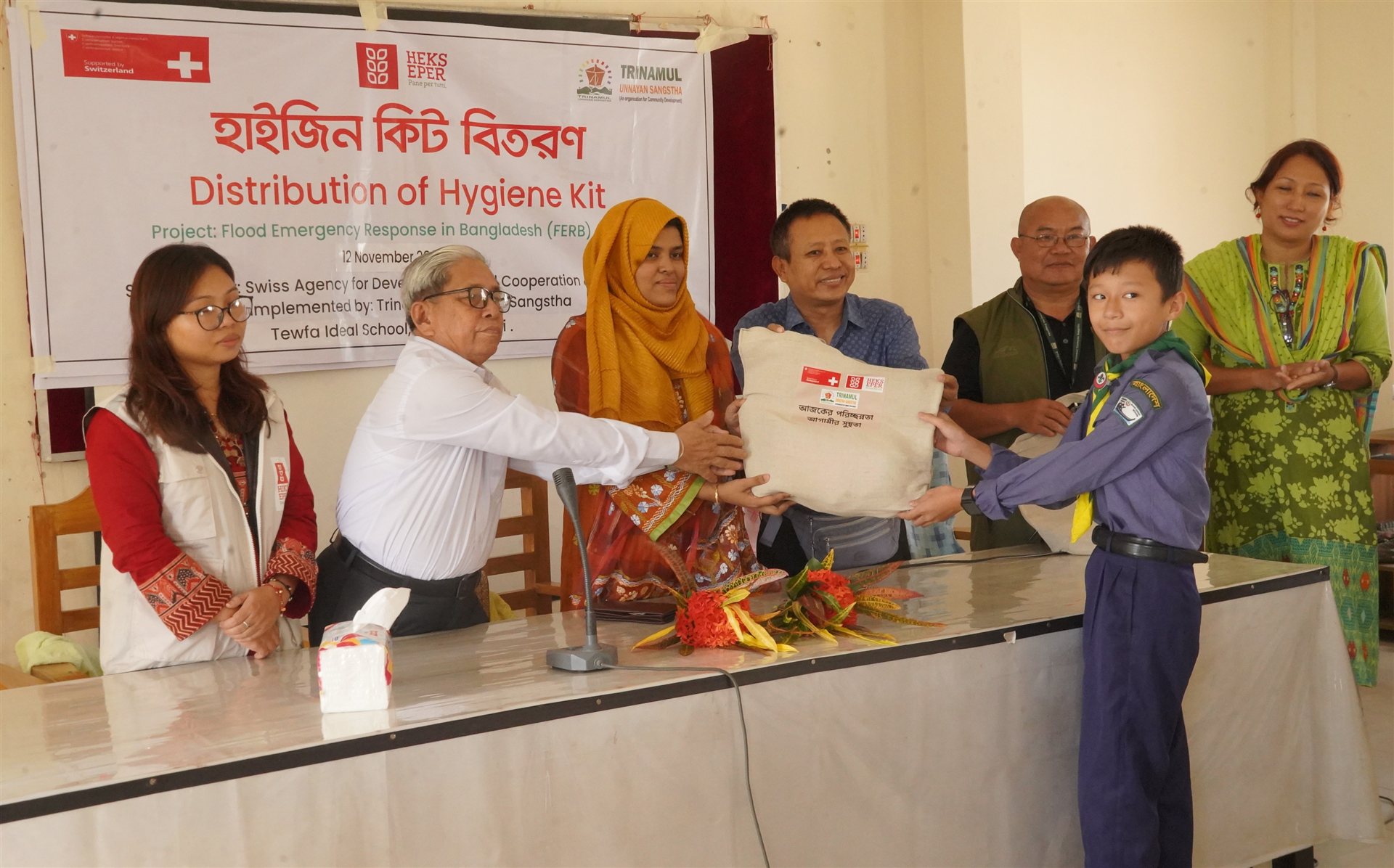
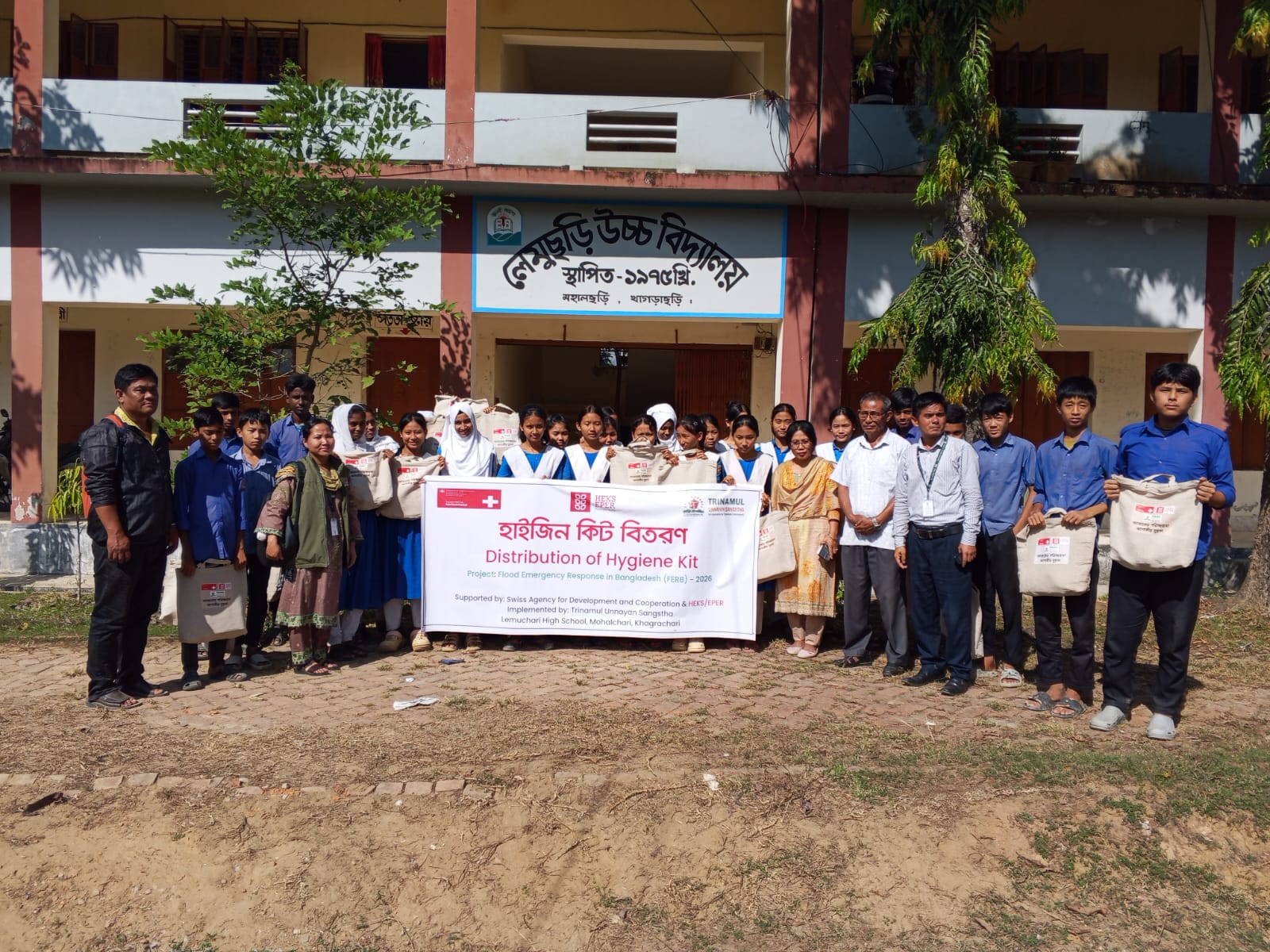
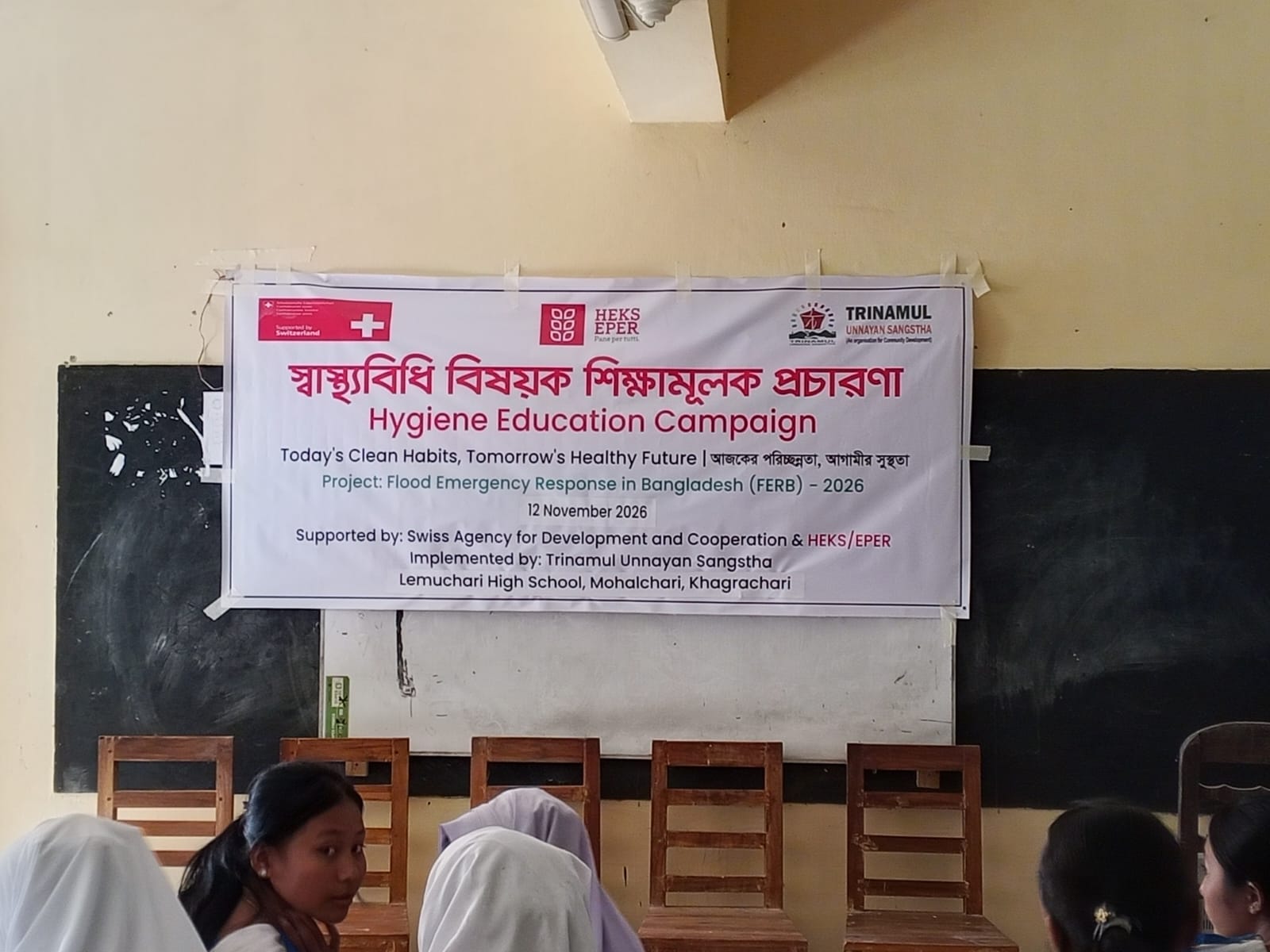
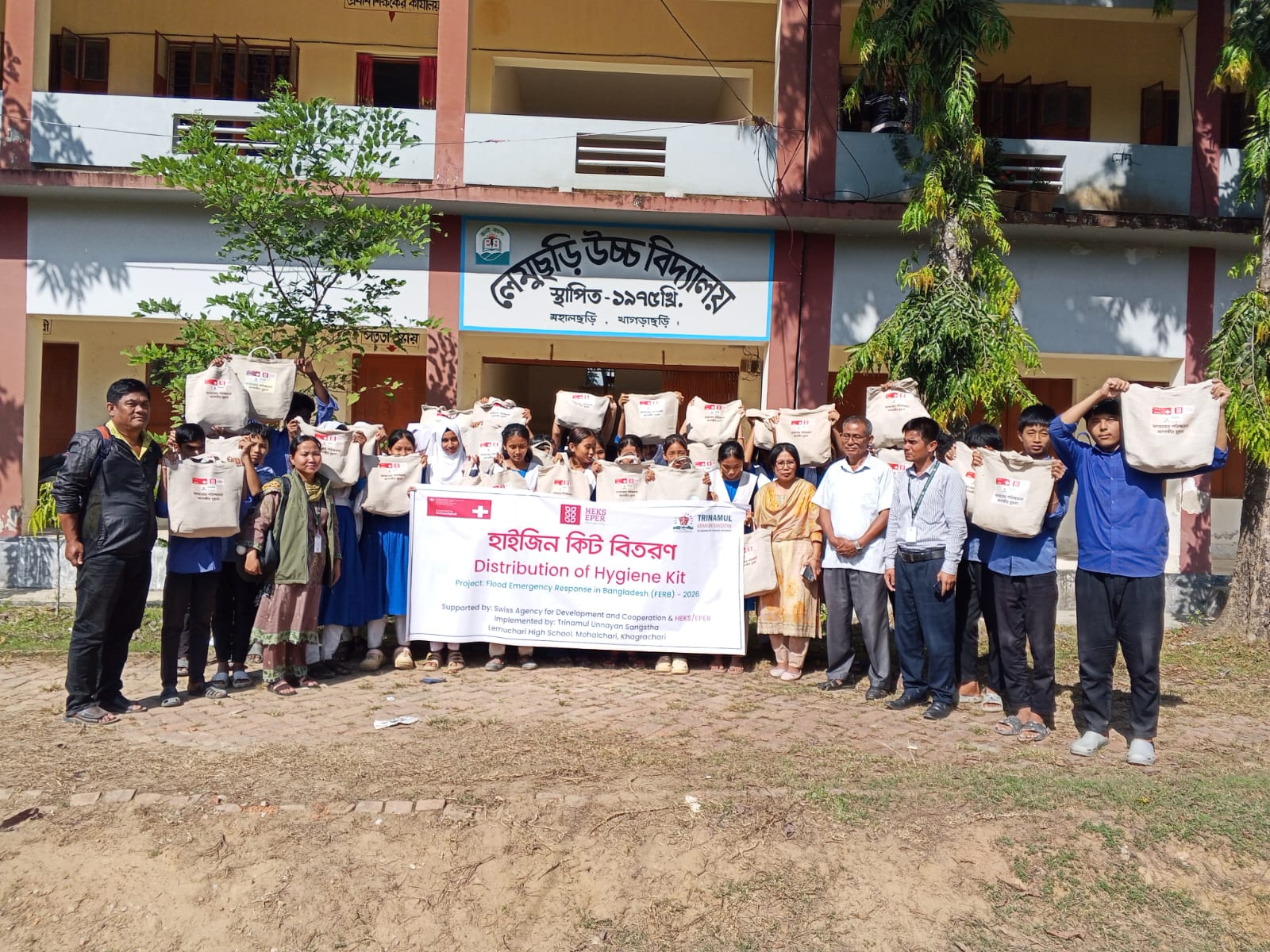
Related FERB school activities at Lemuchari High School
The following supplied photographs show Lemuchari High School, Mohalchari, as identified on the school sign and programme banners. They are separate from the TEWFA event described above. Photos: TUS.