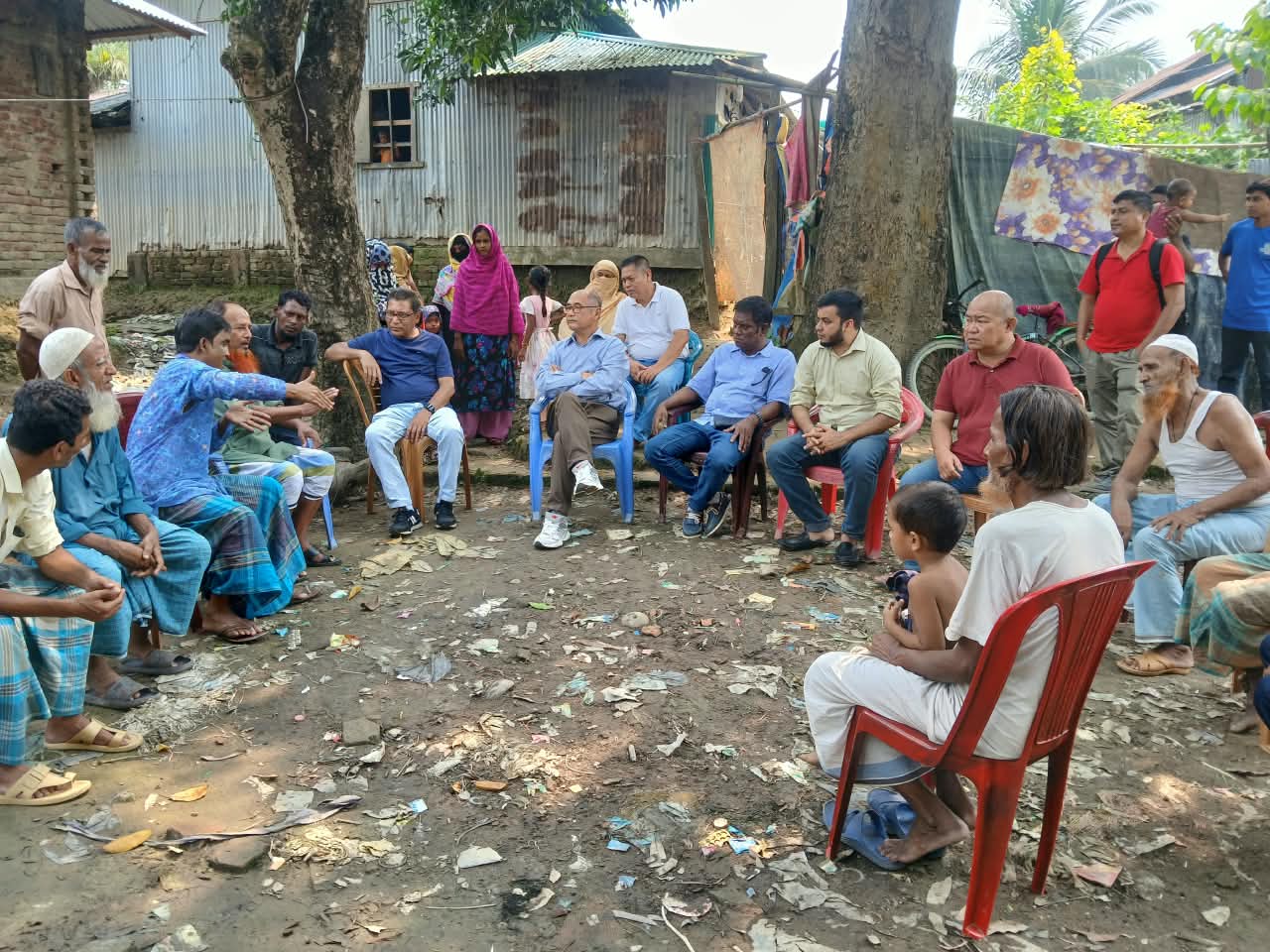
On 5 October 2026, a HEKS/EPER delegation, alongside Trinamul Unnayan Sangstha (TUS) teams, engaged directly with flood-affected communities in Dighinala Upazila, Khagrachari District, to assess recovery progress and strengthen programme partnership under the Flood Emergency Response in Bangladesh (FERB) initiative.
The field visit was led by Biplob Chakma, Project Manager, TUS-FERB Project, and accompanied by Dhaneswar Dewan, Program Manager, and Biswajit Chakma, EC Board Member of TUS, along with the HEKS/EPER team, including Humanitarian Aid Delegate Shah Liton.
The team visited Shantipur, Pablakhali, and Chittagongian Para in Merung, where HEKS/EPER and TUS representatives met with residents to hear firsthand accounts of their flood recovery challenges and observe ongoing interventions supporting water supply, sanitation, hygiene, shelter, and livelihoods restoration.
The field engagement enabled candid dialogue between community members and programme teams and highlighted the importance of transparent beneficiary verification, clear communication of eligibility criteria, and active collaboration with local leaders. The joint HEKS/EPER and TUS presence also created a shared understanding of the complexities of flood impacts and the adaptive nature of recovery as households rebuild and repair their homes.
Key observations from the visit emphasized that community engagement is essential for gaining accurate insight beyond surveys, verification processes require time and repeated visits to ensure fairness, and local leadership must be carefully involved to maintain transparency. The visit further reinforced that sustainable intervention success depends on community ownership and maintenance of water and infrastructure facilities.
HEKS/EPER and TUS teams discussed ongoing challenges such as managing community expectations, coordinating with para leaders, and planning fieldwork within difficult terrain and limited time. Recommendations included continuing joint verifications, improving pre-survey communication, adequately documenting community feedback, and adjusting programme targets based on field evidence.
The visit concluded with a commitment to close communication loops with affected communities and maintain a responsive, accountable approach as the FERB programme advances through its 2026–2027 implementation phase, aiming to assist over 3,000 households across Khagrachari Sadar, Dighinala, and Mahalchari.
This collaboration exemplifies HEKS/EPER’s dedication to supporting vulnerable populations through informed, transparent, and community-centered emergency response efforts.